Work / coursework
HouseHub
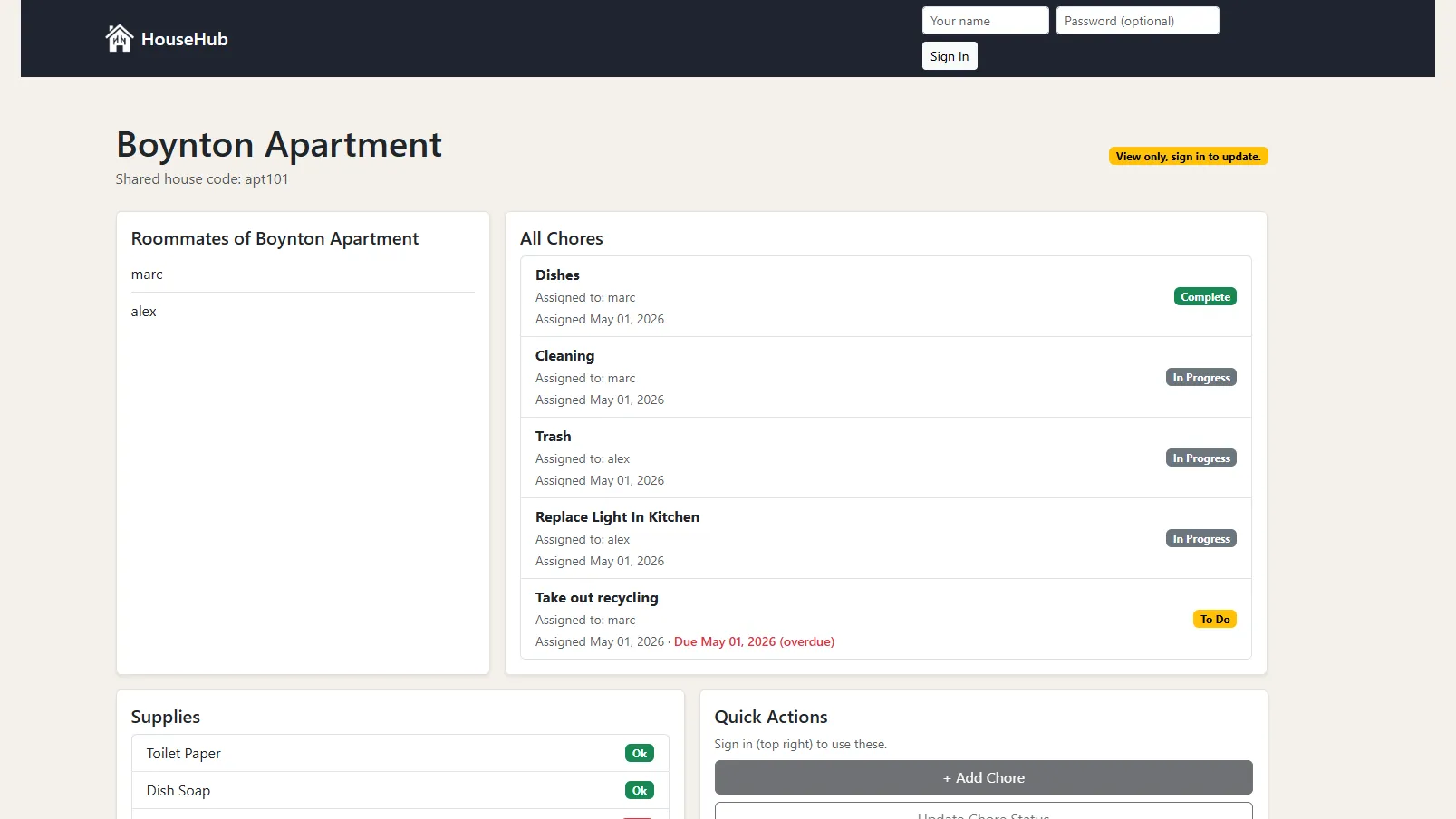
Hi-fi Flask prototype for an HCI course: one shared dashboard where roommates track chores, supplies and maintenance issues.
- Kind
- coursework
- Status
- complete
- Role
- solo
- Period
- Apr 2026 – Apr 2026
Problem
Shared apartments run on memory and nagging. Chores get done twice or not at all, nobody notices the toilet paper is gone until it matters. The leak under the sink is everyone’s problem and therefore no one’s.
This was built as a hi-fi prototype for an HCI course. The goal was a thing real people could be sat in front of and asked to use, not a production service. That framing drove almost every decision below, including the ones that would be wrong in a shipped product.
Data
No external dataset. The domain model is the artifact:
- House: a named household with a join code, owning everything below.
- Roomie: a member of one house;
Flask-Login’sUserMixin. - Chore: title,
todo/in_progress/complete, optional assignee, assigned timestamp, optional due date. - Supply: a consumable with an
ok/low/outstatus. - Issue: a maintenance report with
open/resolvedand a reporter.
Every child cascades from House with all, delete-orphan, so deleting a
household leaves nothing orphaned. The app seeds one demo household on first
boot so the prototype has something to show the moment it starts. The
seed data is fictional.
Approach
A single Flask blueprint, server-rendered Jinja templates, SQLite through
SQLAlchemy’s typed Mapped[] API and Bootstrap 5 over a small amount of
hand-written CSS.
The interface is deliberately one page. /house/<code> renders roommates,
every chore, supplies and issues together, because the research question was
whether a household would keep a shared board current. A board that hides
half its state behind navigation cannot answer that.
Mutations are small, single-purpose POST routes rather than one form: update a chore’s status, add a chore, update a supply, report an issue, resolve an issue. Each one re-validates that the target row actually belongs to the household in the URL before touching it, so a guessed row id from another house 404s instead of writing.
One ownership rule is enforced server-side: only the roommate a chore is assigned to can change its status. Supplies and issues are deliberately open to anyone in the house, since the point of tracking them is that whoever notices, reports.
Experiments
No quantitative evaluation was run. This was a prototype built to be used and observed. Inventing numbers for it would be worse than having none.
What didn’t work
Password hashing that nothing calls. Roomie has set_password and
check_password built on Werkzeug’s generate_password_hash. The login route
uses neither: it compares user.password as plaintext. An unrecognised
name silently creates an account. That was the right call for a usability
study, where a login wall means you learn nothing about the actual task, and
it is the first thing that would have to go before this touched a real
household. Both paths still exist in the code, which is honestly just
confusing to read.
A dead forms.py. The file imports Course, Instructor, Student,
Major and Faculty from app.main.models, none of which exist here; the
models are House, Roomie, Chore, Supply, Issue. It is a leftover
scaffold from a different Flask app, it depends on Flask-WTF and
WTForms-SQLAlchemy which are not even in requirements.txt. It would
raise on import. Nothing imports it, so the app runs fine, which is exactly
why it survived. Every form in the app is hand-written HTML posting to a
route.
Multi-household exists in the schema and nowhere else. House has a
unique join code. Every route is parameterised by it, but / hard-codes
a redirect to apt101 and no UI ever creates or joins a second house. The
data model can do it; the prototype never earned it.